
Idea Size
Is this a short story, a novel, or a 6-season TV show?

When I was out to dinner with a friend last month, the conversation turned to storytelling mediums. My friend related that at film school, he’d been taught to ask himself, with every idea: Is this a short film? Is it a full-length movie? Is it a song?
I was fascinated. “Wait, they gave you a method for determining the ideal medium for a given idea? Can I hear it?”
“Oh, no, they didn’t tell us how to figure that out. It was just a provocative question we were supposed to ask ourselves.”
“It would be so useful to have a method,” I said wistfully. And then, the fateful words: “Someone should make a quiz.”
I don’t exactly have a quiz for you—yet—but I have been thinking about how to tell if a given idea is the size of a novel, or a short story, or a poem, or an essay, or a song. So for this post, I’ll try to work out a method for determining the “size” of the idea you have on your hands.
First, let’s make a distinction between size and medium. It’s possible that certain ideas are ideally suited for certain mediums, but that’s an argument I don’t feel qualified or scholarly enough to make. For example, is horror inherently better-suited to movies than to books? Eek! I don’t know! I bet someone could make the case. But for our purposes, we’ll think of medium as a ladder, and size as the different rungs on that ladder. Like so:
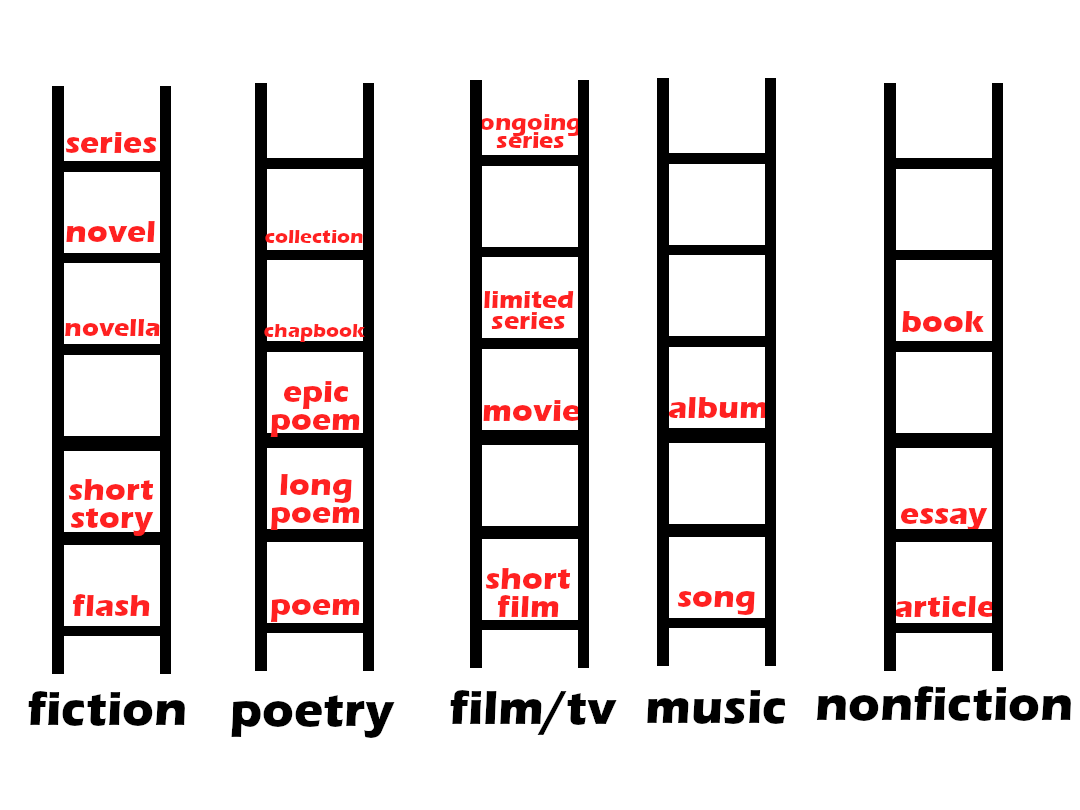
As you can see from this very technical graphic, every medium can accommodate differently “sized” ideas. If you come to me with an idea and you tell me you want to do something musical with it, I can tell you, “That should be an album,” or, “That should be a song.” But if you come to me with an idea and ask, “What should this be?” and I tell you, “It should be a song,” that won’t be much help to you if you’re not a musician.
So medium, at least as I’m defining it here, should be determined by your skills—the ones you have, and the ones you’re willing to acquire. Me, for example, I write fiction and music. So when a new idea comes to me, I might briefly wonder: huh, is this a song or a story? But I’m not going to waste my time wondering: should this be a short film??
You know how to do certain things, and your ideas will naturally suggest themselves to you in the form of things you know how to make. So once you’ve chosen from among the mediums available to you—if you’re a virtuoso in all artistic disciplines, this could be difficult—all that’s left is to figure out what size of an idea you’ve come up with. In other words, how far up the chosen ladder your idea can climb.
The #1 best way to determine this is to go ahead and make the thing. You may start out thinking you’re writing a novel, only to discover that you only have about 25k words of things to say. Or you might try to write a 3k-word story and find it gets longer and longer and longer and longer…
But let’s say, for whatever reason, that you need to figure out what size this new idea is before you embark on the execution. In that case, you’re going to want to follow along with my absolutely failproof exercise below.
The first step is to figure out the one-sentence premise of your new idea. Yes, I know it doesn’t fit in one sentence. But try to stuff it in there anyway. Not only am I going to ask you to fit your idea-premise into one sentence, I’m going to ask you to use some of my words to do it.
You know that feeling when…
You know that feeling when you’re standing at a fork in the path of a yellow wood, and you’ve got to decide which way to go, and it really probably doesn’t make a difference but you’ve still got to choose left or right?1
You know that feeling when you hear a tapping at your chamber door and you’re pretty sure it’s just some nighttime visitor, but then you open the door and it’s a raven croaking “nevermore” at you?2
You know that feeling when you’ve just met someone and this might be totally crazy, but you still want to give them your number in case they’ll call you maybe?3
Songs, poems, flash fiction—everything on that lowest rung of the ladder is meant to capture a feeling. There might be some story in there, some hint of a progression, but it’s all in service of absolutely nailing that specific feeling.
I have a flash fiction piece that I published in Fence a while back. It’s 550 words, and it’s about a couple watching their favorite TV show late into the evening as they turn into ugly bleary glazed-over husks of themselves. Not literally—nothing actually happens in the story. They just watch TV.
What inspired this story was simple: You know that feeling when you’re watching endless episodes of TV with the person you love, and then you have that out-of-body moment where you realize how repulsive you must both look from the outside, all slack and glazed and etc., and then even as you keep watching TV you can’t quite forget that moment of revulsion?
So if your idea fits into the “You know that feeling when…” framework, it’s a good sign that your idea is suited to a shorter form. Flash fiction, if you’re a fiction writer; a poem, if you’re a poet; and so on.
Obviously, the majesty of your flash/poem/song/etc. might not totally come across in the paraphrase. That’s why we bother writing entire poems instead of just one-sentence paraphrases. But if what you’re getting at is a feeling, however complex or layered the feeling, you’ve probably got a Rung 1–sized idea on your hands.
…but it didn’t work.
We set up a death-by-stoning lottery in order to give people an ethical outlet for their violence and barbarism, but it didn’t work.4
A husband and wife sacrificed their most precious possessions in order to surprise each other with a nice Christmas gift, but it didn’t work.5
I wanted to experience for myself the epiphany via torture that I inflicted on all my previous prisoners with my government-issued death machine, but it didn’t work.6
The next rung up—the slightly longer idea—can’t be paraphrased as just a feeling. These ideas are bound up in cause and effect, effort and consequence. Someone tries something, and that attempt meets its end: it doesn’t work.
Even stories that lack a clear, causal plot can fit into this framework. Take Daniel Orozco’s “Orientation,” a short story framed as a tour around the cubicles of a slightly surreal office. Nothing much happens in the present tense, but you still can’t really fit the vibe of the story into a Rung 1 construction: “You know that feeling when it’s your first day at the office and someone’s showing you the ropes but then they keep mentioning weird things about their coworkers, including the one who’s psychic and the one whose dead wife haunts the office and the one who hides in the women’s bathroom…” Hmm. Getting a bit unwieldy. How about: “We tried to separate our personal lives from our workplace lives, but it didn’t work.” That the personal will inevitably bleed into the professional is a better summary of the story’s argument.
Actually, maybe that’s another way to think about this second rung of idea size: it’s not a feeling but an argument.
I’ve got a story in TriQuarterly about a robot who is assigned to the front counter of a donut shop. The robot proves herself to be an ideal employee, but she also unexpectedly develops an attachment to donut-selling, such that, when she’s reassigned, she is devastated to leave behind her calling as a donut salesman. I think the argument of the story could be fairly paraphrased as: “We tried to remove the human element from menial labor, but it didn’t work.”
I don’t mean to suggest here that all short stories have to be negative. If you, like my workshop students last semester, believe that more stories ought to have happy endings, you can still use the same framework: “Everyone tried to stop the plucky a cappella group from winning Regionals, but it didn’t work.”
Take out your one-sentence idea again. Uncrumple it. See if it fits the but-it-didn’t-work construction any better. If it does, you’ve got a short story on your hands. Or a short film, or an essay, or a sizable papier-mâché project, depending on your craft of choice.
Therein lies the paradox.
Creative partnerships can be so intense and all-consuming that they begin to compete with romantic partnerships—and yet if a creative partnership turns romantic, the creative element will almost certainly be ruined. Therein lies the paradox.7
Harry believes that men and women can’t be friends due to inevitable sexual tension, and yet he strikes up a decade-long friendship with Sally. Therein lies the paradox.8
Edward is madly in love with Bella, and yet he also has the irrepressible urge to drink her blood and thus kill her. Therein lies the paradox.9
Novels, movies, poetry collections, and other long things grapple with paradoxes that can’t be easily resolved. Where short stories are all about trying one solution to a problem, novels throw a whole bunch of solutions at the problem, eventually landing on the right one—OR eventually concluding that the problem is unsolvable, some contradiction inherent to human life that everybody has to deal with in their own way.
Romcoms are a good example of the first case, where the paradox turns out to be solvable. “She’s engaged, but then she meets this other really hot guy. Therein lies the paradox.” We can guess that she’s eventually going to land on a satisfactory solution here.
Take any weighty novel as an example of the second case. Like Infinite Jest: “The things that keep our existential despair even a little bit at bay are making our existential despair worse. Therein lies the paradox.” The novel isn’t going to resolve that paradox; it’s just going to show you a lot of characters trying and failing to grapple with it in their individual ways.
My debut novel is a whole tangle of characters and situations and winding conversations, but the idea I was grappling with can be boiled down to something like: “Our pivotal, life-altering decisions are often reached through a series of coincidences and impulses of the moment, and yet we’ve got to pretend (for our own sanity) that these decisions are linked by some intelligible throughline of gut instinct and narrative arc. Therein lies the paradox.”
So if fitting your idea into the “but it didn’t work” construction was a bit of a squeeze, try restating it and appending “Therein lies the paradox.” If you’ve got a good, juicy paradox that’s going to take a whole book to solve—or a whole movie or poetry collection or what have you—then move yourself up a rung.
Even though / always / never.
Okay, this one’s a little less pithy. But take a look at your “Therein lies the paradox” construction. Did you find yourself using the words even though or always or never? That could be a sign that you’ve got a longer-running project on your hands. For example:
Even though the ring of power might enable the Dark Lord Sauron to rise to power again, the ring is so awesome that no one who comes into its possession can ever bear to destroy it. Therein lies the paradox.10
Even though Harry Potter and Voldemort are uniquely capable of destroying each other, they will always continue hunting each other down until one of them kills the other. Therein lies the paradox.11
Even though Logan Roy’s failchildren are fundamentally unequipped to run a megacorporation, they will never stop trying to take over and get out from under their father’s shadow. Therein lies the paradox.12
The word that film producers have for this is “engine.” Does the idea have an engine that’s going to keep things churning in perpetuity? Is there some unresolvable paradox that’s going to keep the characters forever chasing their tails? Or will the paradox at least take a really long time to resolve?
This last rung is really infinite rungs. You can come up with a concept that never has to end—for example, your standard crime show: “Even though there will always be more serial killers out there killing, Joe and Susan will always show up on the crime scene in the hopes of putting every last serial killer behind bars. Therein lies the paradox.”
Sitcoms, crime shows, soap operas—they’re all meant to go on and on forever. The examples I gave above, though, are designed to come to an eventual resolution. Harry Potter and Voldemort are eventually going to meet up and successfully kill each other—you couldn’t get fifteen seasons out of their cat-and-mouse chase. (Though HBO Max is certainly going to try.)
So if the paradox that you worked out at the last rung has some always-never energy to it, your idea might be big enough to sustain a whole series.
What if my idea fits all four categories?
Let’s say you have an idea, and you’ve been on the fence about whether it’s a novel or a short story or something else entirely. So you read through this whole post and you did the exercise and you restated your idea four different ways, befitting each rung of the ladder. And at each rung you managed to stretch or squeeze your premise into the right shape for the given prompt. And they all basically worked.
What then?
Well, my first question for you would be whether you noticed an especial strain at any of the rungs. Was it really easy to fit your idea into you-know-that-feeling-when form, and really hard to come up with a good therein-lies-the-paradox construction? That might be a sign that your idea is on the shorter side. Of course it’s always possible to bend and mold an idea into any of these four forms, but which one felt the most natural? Which construction really nailed the idea you’re trying to get across?
It’s possible that your idea could make for a great short story or a great novel, depending on how you tweak it. In that case, my next question would be: which result is most useful for your writing career? If you’re just starting out with fiction, exploring the idea in a short story probably makes more sense than diving into a novel. If you’ve got a million short stories but you’ve never attempted anything longer, this could be the time to try a novel.
So if your idea really truly works at multiple levels, you can go ahead and choose whichever one makes sense for you right now—knowing, of course, that the process of writing might reveal to you that your idea is smaller or larger than you thought it was.
And if you’re still at a loss to decide how big of a project to embark on, my third question is: how long will you stay obsessed with this idea? If you’ll lose steam on the idea within a month, you should write something short. If the idea is interesting enough to keep you going for a full year, you should still write something short, unless you write very fast. Given the timeline of the publishing process (2 years from conception to publication at an absolute minimum, often 5+), if this idea of yours results in a novel, you’re going to have to keep caring about that idea for the next 5+ years of your career. If you do a good enough job on the novel, people will still be asking you about it twenty years on. So this idea can’t just be therein-lies-the-paradox big—it has to be ongoingly interesting to you for the foreseeable future. (That’s why it helps to choose a really gnarly paradox.)
Everything I said above, but easier to skim
The four idea sizes:
You know that feeling when [idea]?
[idea], but it didn’t work.
[idea]. Therein lies the paradox.
Even though [idea], always [idea]. Therein lies the paradox.
The three questions:
Was your idea a natural fit for any of the above categories?
Which idea size would be most useful for your writing ambitions?
How long will you stay obsessed with this idea?
I know we’re all a little cagey about sharing our ideas, since we don’t want to be scooped. But if your idea falls somewhere in between ladder rungs, feel free to summarize it very vaguely and mysteriously in the comments, and I can weigh in. Feel free also to disprove my whole schematic here, which I’m sure can be blown apart in seconds by a few choice counterexamples.
Stay tuned for my next post, in which hopefully I find an excuse to make a proper quiz!
“The Road Not Taken” by Robert Frost
“The Raven” by Edgar Allan Poe
“Call Me Maybe” by Carly Rae Jepsen
“The Lottery” by Shirley Jackson
“The Gift of the Magi” by O. Henry
“In the Penal Colony” by Franz Kafka
Tomorrow, and Tomorrow, and Tomorrow by Gabrielle Zevin
When Harry Met Sally by Nora Ephron, directed by Rob Reiner
Twilight by Stephenie Meyer
The Lord of the Rings by J. R. R. Tolkien
Harry Potter by J. K. Rowling
Succession by Jesse Armstrong
Great write-up, Devon. I'd never heard anyone distill the "even though"/"always" test like you have, and I had an epiphany. I'm plotting a novel this year and want it to stay open for the possibility of it turning into a trilogy or series. The "even though"/"always" test gives me a lane to set aside an aspect of the MC's character's yearnings in my WIP that can carry forward across novels. I'm bookmarking this post, for future reference.
Devon, this is brilliant. You put into words exactly what I’ve felt this past year while working on a novel idea—it’s the first idea I’ve really obsessed over and not gotten tired of, no matter how much time I spent with it. Thanks for putting together such a great post!